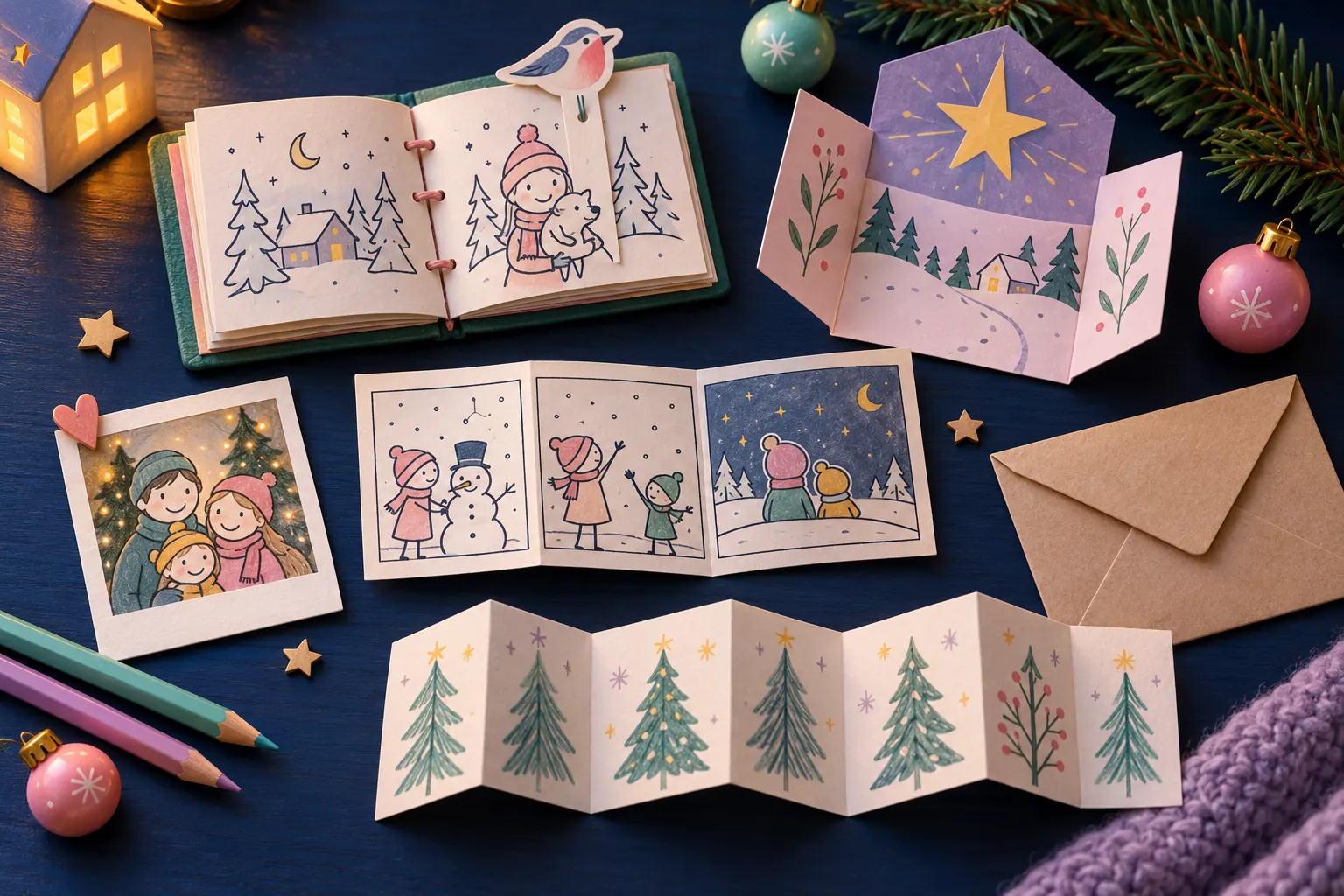
A home printer can help you make Christmas gifts that carry something personal: a story, a photograph, a question, a drawing, or an invitation. The cheapest useful project is usually the one that suits the recipient and the supplies you already have. Printing ten different things is not the goal.
The ten ideas below are for an ordinary paper printer. Each gives you a different way to contribute something of your own. Some need only one sheet; others work as a small collection. You can choose one without buying a cutting machine, laminator, or pack of specialist paper.
Two ready-made starting points
Our shop connection: Cheap Gifts and the Etsy shop jesusgenerationpics share an owner. The following are our own optional templates. USD download prices were checked on October 27, 2026, before tax and printing.
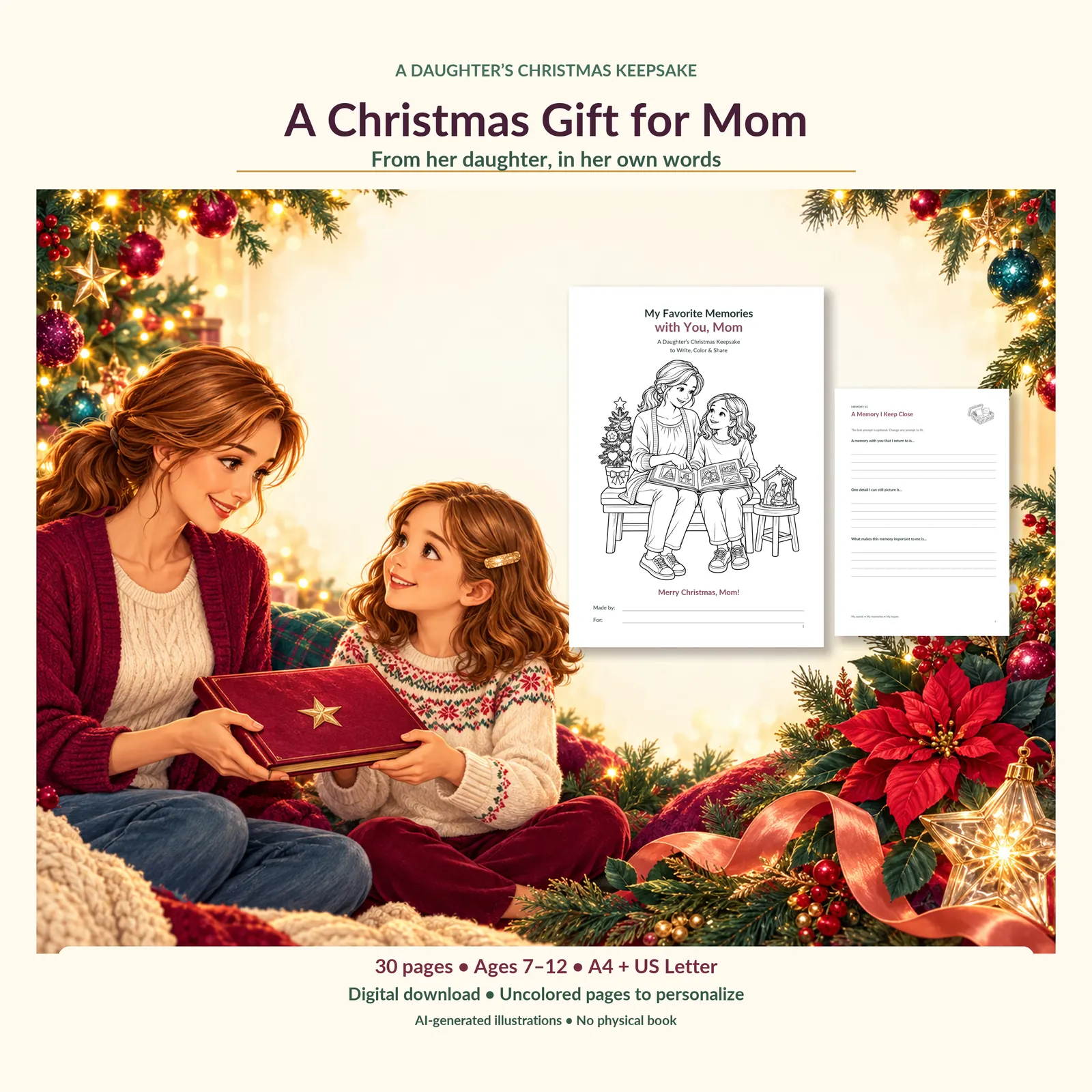
My Favorite Memories with You, Mom — $6 offers a 30-page Christmas memory-and-coloring book for daughters around ages 7–12. A4 and US Letter versions include personal prompts and selected Nativity artwork. It fits the mini-book idea below when the child wants to tell real stories about time with Mom.
Dad, You're My Role Model — $2 is a different 30-page coloring-and-memory book for boys around ages 5–11, also in A4 and US Letter. Its gentle Christian themes and appreciation prompts suit a child who wants help finding something specific to say about Dad.
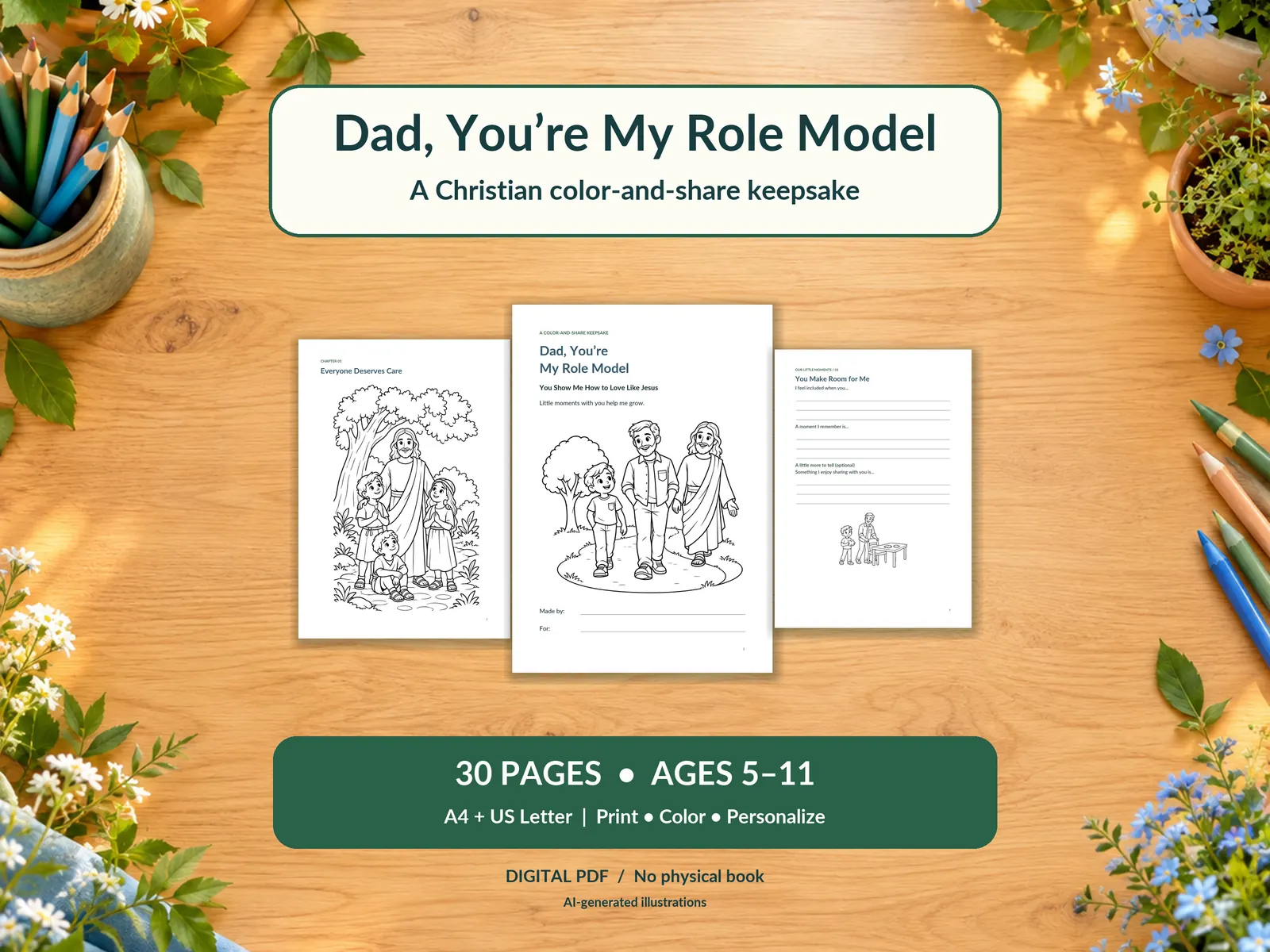
Both are digital blank templates, not physical books or automatically fillable files. The main artwork is uncolored. Check the age guidance, content, and personal-use licence before choosing; completed physical gift use and forwarding a PDF are different permissions. You can also make every project below from your own original material.
What will make this gift personal?
Before choosing a project, jot down the recipient and one thing you could contribute: a story you can tell, a picture you can use, or an activity they would welcome. If all you have is an attractive blank layout, keep looking for the personal part. It can be as small as a question on a bookmark.
1. A completed memory mini-book
Choose three or four moments and give each enough room to be readable. A drawing can introduce the scene; a short paragraph can explain the detail. Add a cover with the recipient's name and yours, then keep the assembly simple.
This suits someone who enjoys your words and pictures. A few completed pages are more useful than a whole book of prompts they must answer themselves. If you leave space for something to do together, label it as an invitation.
Your personal contribution is the selection: why these memories, and what do you notice about them now? For a focused example, see our DIY Christmas gift guide for Mom. A purchased template can supply structure, but it cannot supply the truth of your relationship.
2. A photo-and-caption pair
Print one photograph and a separate short caption or letter. The picture gives the recipient something to look at; the words explain what happened just outside the frame. Keep the text readable rather than shrinking it into a decorative corner.
Use a photo you have permission to print and that the people shown would be comfortable receiving. If the photo is low quality, a smaller print may be more suitable than a large one. Do not promise that changing resolution metadata will make missing detail appear.
A folded paper backing can present the two pieces together. If home photo printing is inconvenient, Walmart Photo lists a 4×6 print at $0.18, before tax and fulfilment costs. That can be an alternative to buying a whole photo-paper pack for one picture.
3. A bookmark with a personal reading question
Design a simple bookmark around a shared interest: a place, an animal, a colorable pattern, or an original small drawing. Add a question such as what book the recipient would recommend to you next. Use your own wording rather than reproducing a long quotation or song lyric.
Leave a generous border around the cutting line. Ordinary paper can be folded for a simpler version; only use heavier paper if your printer supports it. A ribbon and laminating pouch are optional costs, not requirements.
This is particularly suitable for someone who already reads. You do not need to buy a book to justify the gift. If you tuck it into a borrowed or owned book, do not write on or alter the book without permission.
4. A family recipe story sheet
Ask permission to record a recipe the family is happy to share, then pair it with a short account of why you remember it. The story might be about who enjoyed making it, a familiar serving dish, or a harmless moment around the table.
Keep the recipe accurate and separate from your commentary. Do not invent ingredient quantities, cooking instructions, or substitutions to fill gaps. If you do not have a reliable recipe, make a memory page about the meal instead of presenting it as a usable cooking guide.
Avoid copying someone else's published recipe prose or photographs. The recipient may enjoy a simple sheet with your own illustration more than a pretend cookbook assembled from uncredited material.
5. An original mini-comic
Use three panels: a reasonable plan, an unexpected turn, and the detail you still laugh about. Stick figures can work. The important thing is clear reading order and enough space for any short dialogue.
Label an invented adventure as imaginary. If you use a real event, avoid presenting approximate dialogue as a verbatim quote. Keep the joke shared and kind; a Christmas comic should not become a way to embarrass someone publicly.
This suits a recipient who likes your humor more than elaborate decoration. You can leave a final small panel for an optional sequel together. For Dad-specific ideas, see funny Christmas gifts that keep him in on the joke.
6. A simple activity invitation
Print a ticket or folded card for something feasible: a game you own, a library visit, drawing together, or an agreed call. Leave time and place open if you cannot arrange them yourself. The recipient should be able to help shape the plan.
Do not promise a paid meal, travel, or another person's help without permission. Avoid turning affection into a redeemable obligation. “Would you like to choose a time?” is a useful phrase because the gift remains an invitation.
A small illustration of the activity makes the paper feel intentional. You do not need to imitate a real company's ticket, include a fake booking number, or pretend anything has already been reserved.
7. A family observation game
Create a handful of original prompts about noticing ordinary things: find something shaped like a star, spot two objects in the same color, or draw an animal with a very serious expression. Adapt the activity to the participants' ages, access needs, and interests.
Keep pieces large enough for their intended users, and ask an adult about suitability for young children. You can put all the prompts on one sheet instead of cutting many cards. Nothing needs to be timed or scored.
This is a shared-activity gift, not a copied commercial game. Make the prompts yourself and avoid asking people to reveal private information or perform something uncomfortable.
8. A small art print with permission
Use your own drawing, a photograph you are allowed to print, or artwork whose licence permits this physical gift. Choose a size that suits the source image. Large paper does not automatically make an image better.
For a small finished piece, a 4×6 IKEA FISKBO frame is $1.99 at the price checked on October 27, 2026, before tax and delivery. It is for a deliberately sized 4×6 piece, not an entire A4 page. An existing frame or plain backing is an alternative.
Add a separate note explaining why you chose the image. Do not claim someone else's artwork is yours, and do not remove a watermark from a preview to create a gift file.
9. An accordion memory strip
Arrange a short sequence of small drawings or suitable photos on a strip that folds into panels. Each panel can carry one event or detail. Keep the number small enough that the strip opens without becoming awkward to handle.
This works when the order matters: the start of a day, a funny change of plan, and the part you remember afterward. Test the folds on spare paper before printing the final version. Leave image content away from the fold lines.
You can make a simpler folded card if joining strips would require materials you do not have. The story is the gift; the clever folding is optional.
10. A small personal reading or gratitude journal
Print a few spacious pages and make a cover connected to the recipient's interests. A reading journal might offer room for a title, a favorite detail, and a question. A gratitude journal can have an optional prompt rather than a demand to feel positive every day.
Only choose this if the person enjoys writing or drawing. A journal can otherwise become unfinished homework. You might complete the first page with your own note explaining why you thought they would enjoy it, while leaving their responses blank.
Do not advertise a handmade paper journal as a treatment or promise that it will improve mental health. It is a personal stationery gift, with room to use or ignore the prompts.
Choose by the personal input, not the number of pages
| Your strongest material | Good candidates | Main finishing task |
|---|---|---|
| A story you want to tell | Mini-book, recipe story, mini-comic | Write clearly and put the parts in order |
| A suitable photo or drawing | Photo pair, art print, accordion strip | Choose a usable size and presentation |
| An interest or activity | Bookmark, invitation, observation game | Make the idea specific and feasible |
| A recipient who enjoys writing | Reading or gratitude journal | Leave comfortable blank space |
Imagine a maker, Ella, with an ordinary printer, some paper, and three recipients. She has a suitable photo, enjoys drawing simple characters, and knows one recipient is a reader. She chooses a bookmark, a photo caption, and a comic. The accordion idea can wait: it asks for folding and joining she does not particularly want to do this time.
Those three gifts use different personal material without requiring three new sets of supplies. The printer handles reproduction; Ella chooses why each piece belongs to someone.
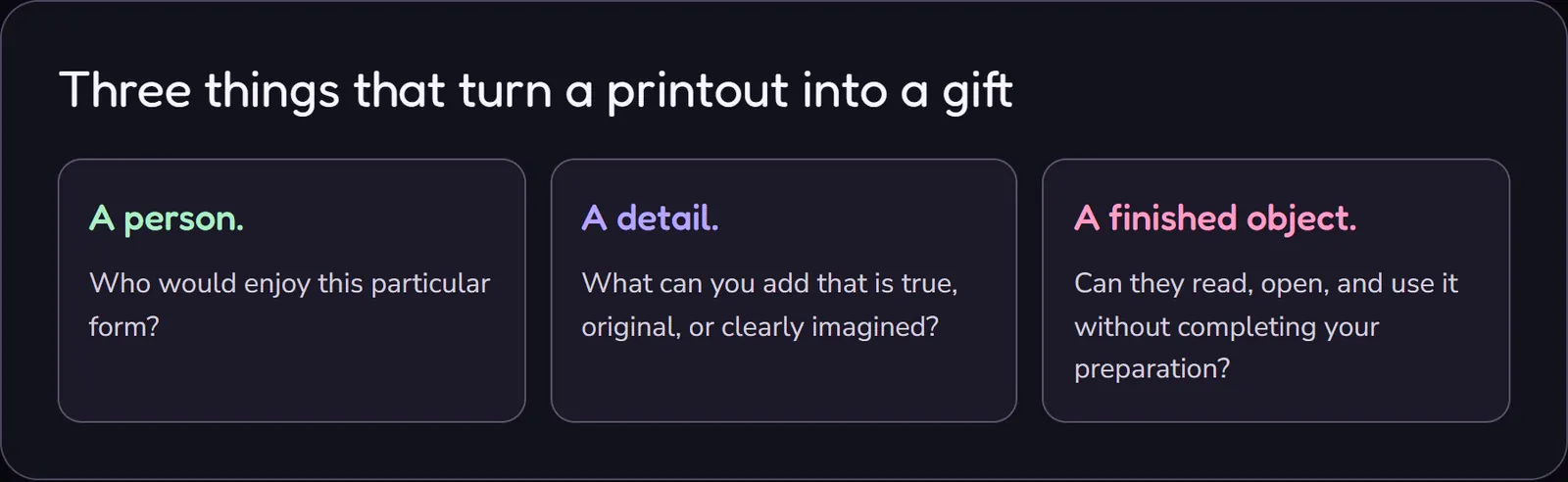
- A person.Who would enjoy this particular form?
- A detail.What can you add that is true, original, or clearly imagined?
- A finished object.Can they read, open, and use it without completing your preparation?
View the personal-content guide as an image
Keep the printing route proportionate
Mostly words and line art
Start with supported ordinary paper. Check readable type and clean outlines on one proof.
A photo-led gift
Check the image at its intended size. Compare one local photo print with buying new home-printing supplies.
Neither route has a universal cost. Include the actual materials, tax, and fulfilment you need.
Use matching paper-size files and inspect a proof before printing the rest. Our home-printer Christmas workshop explains sizing, clipping checks, and common problems. That guide covers the production process; this list is for deciding what to make.
Keep licence information with purchased files. Do not forward templates or print extra copies for distribution beyond the permission you bought. When you use your own photos, drawings, and words, still consider the privacy of other people involved.
Choose one project and finish its personal content before adding another to the list. A bookmark with a question you mean to ask is ready to give. Ten downloaded layouts with no recipient or message still need the most interesting part of the work.
Lead illustration: AI-generated editorial artwork. Product images are actual shop listing previews and may include illustrative mockups; they are not customer testimonials. Prices are a dated snapshot, not a guarantee of future checkout totals.
A little inspiration, a little creativity, a whole lot of love.
More printable joy →