
“I'm proud of you, Dad” can feel surprisingly difficult to say. You may mean it completely and still wonder whether it sounds too formal, too dramatic, or as though you are giving him a grade. You do not need to solve that with a bigger speech. Start with the thing you noticed.
“I noticed how patiently you listened yesterday. I admire that.”
That is example wording, not a memory you need to adopt. Your own sentence might be about his effort, a kind choice, something he learned, or the way he made time for someone. Pride does not have to depend on his job, income, physical strength, or an impressive public achievement.
When a small book helps you find the words
Shop connection: Cheap Gifts and the Etsy shop jesusgenerationpics share an owner. This is our own optional keepsake. The USD download price was checked on October 27, 2026, before applicable tax and printing.
For a younger son, Dad, You're My Role Model — $2 provides a 30-page coloring-and-memory gift template in A4 and US Letter. It is designed for boys around ages 5–11 and includes gentle Christian content, personal prompts, and 13 dedicated full-page coloring illustrations.
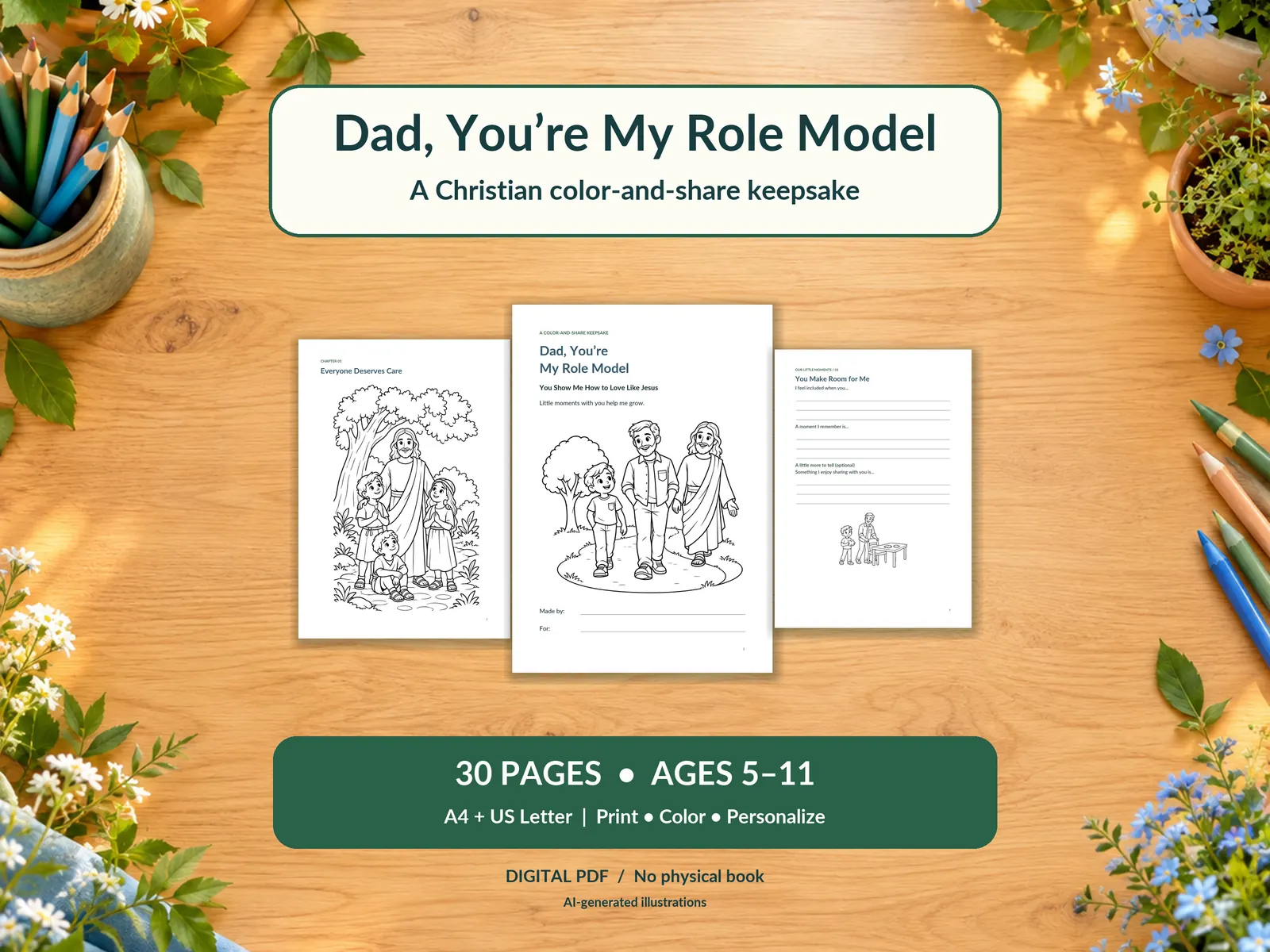
The value of a prompt book is that it gives you somewhere to begin. The important words still come from the child. An adult can help read or write down a child's exact answer without making it sound more impressive. The main artwork is uncolored; it is not a finished personalized book or an automatically fillable file.
If you are an older teenager, an adult child, a daughter, or simply someone who dislikes worksheets, a plain letter may fit better. You can borrow the idea of noticing specific qualities without buying a product designed for a different maker. The message matters more than the format.
Notice the action before naming the quality
Imagine an older child who wants to thank Dad after a conversation about a difficult school project. Dad did not take over the project or produce a perfect solution. He listened, asked which part was stuck, and helped identify one manageable next step.
The first draft says, “You're the best at everything.” The child pauses over it. Dad did not know every answer; he stayed interested while they worked out what to try. In this hypothetical example, patience is the quality the message needs to name.
You can use the same editing move with a different true event. Instead of searching for a grand adjective, write down what a camera or another person could have observed. Then explain what you admired about it.
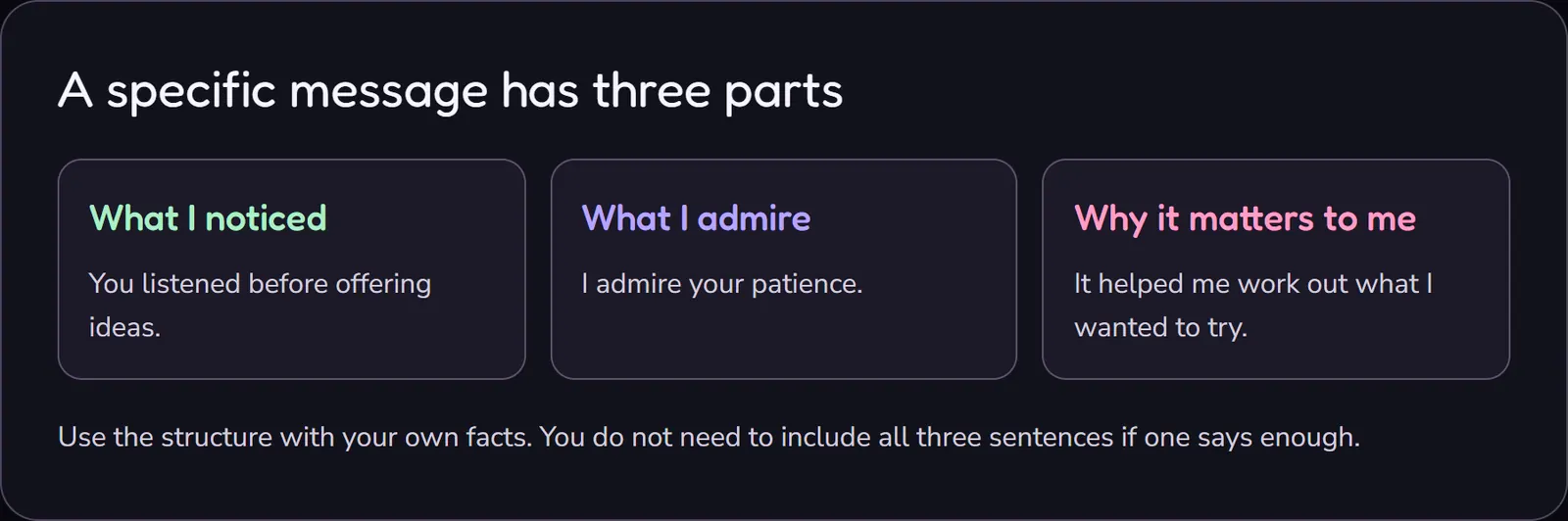
- What I noticedYou listened before offering ideas.
- What I admireI admire your patience.
- Why it matters to meIt helped me work out what I wanted to try.
Use the structure with your own facts. You do not need to include all three sentences if one says enough.
View the message structure as an image
There is no need to describe the private difficulty if you do not want to. “The way you listened last week meant a lot” can be specific enough for the two people involved. A gift does not have to make every reader understand the whole story.
What can you be proud of?
Effort that is easy to miss
Perhaps Dad is practicing something unfamiliar, handling an ordinary responsibility, or making time for a task he finds difficult. Notice the effort without turning it into a demand that he keep doing more.
“I can see how much care you put into that” is different from “You never stop, and that's what makes you great.” The first recognizes a choice. The second can make rest sound like a failure. You can admire someone and hope they get a break.
Kindness without an audience
You may have seen him include someone in a conversation, ask a useful question, or help without making a performance of it. Describe the action and leave other people's private circumstances out of the message.
If you want to share the note publicly, ask first. A quiet act of care does not automatically become your story to publish, especially when another person is involved.
Learning or changing his mind
A role model does not need to be right immediately. You might admire Dad asking for help, admitting he did not understand, or trying a different approach. Choose a detail he would be comfortable having recognized rather than exposing something sensitive.
You do not need to write, “You used to be bad at this.” Focus on the action you appreciate now. A sentence can recognize growth without turning the card into an assessment of his history.
The way he shares ordinary time
Remembering a question, making room at a table, or enjoying a game with you can matter without being heroic. You can be proud of the attention he gives something small.
If the feeling is closer to affection than pride, use that word instead. “I love spending this time with you” does not need to become “I am proud” just because that was the phrase you searched for.
Choose a delivery that fits both of you
A message can be sincere without being a surprise presentation. Decide whether you want to say it aloud, give him time to read it, or make an object he can keep.
| Format | Useful when | Small consideration |
|---|---|---|
| A spoken sentence | You are already sharing a calm moment | Leave room for a short response |
| A text or voice message | You are apart or speaking feels awkward | Use a method he can comfortably access |
| A handwritten note | You want him to read privately | Make the writing clear and sign it |
| A small keepsake | A picture or memory adds something useful | Finish the personal content before giving it |
A note beside a familiar photograph can make a simple physical gift. Walmart Photo lists a 4×6 print at $0.18, and an IKEA FISKBO 4×6 frame is $1.99. Together that is $2.17 before tax and any delivery cost, at prices checked on October 27, 2026. Check local availability and use a photo you have permission to print.
Those are optional presentation costs, not the price of expressing pride. An existing frame, a folded sheet, or a message costs less. Do not buy a frame first and then struggle to invent a memory that fits it.
Edit out pressure, not personality
Read the message once for the effect it might have. Does it appreciate something he did, or does it quietly ask him to remain tireless, cheerful, and available forever?
A claim that asks a lot
You always know the answer and never need help.
A more workable observation
I liked that you helped me think it through, even when neither of us knew the answer yet.
Use the second idea only if it is true. Specific wording should not become a more believable invention.
Keep a familiar joke if that is how you talk, but let the sincere sentence remain visible. You might write a light opening and then say, “The part I really mean is…” There is no need to hide every feeling behind humor. Our funny Christmas gifts for Dad guide explores gifts where the joke and the appreciation support each other.
Avoid copying a polished message word for word if it does not sound like you. Short ordinary words are welcome. “I noticed,” “I admire,” and “I liked that” are useful because they let you name something, not because they are a formula you must follow.
If Dad responds quietly
He may say thank you, make a small joke, look at the note later, or seem unsure what to say. You cannot use the response to measure exactly what the message meant to him. Nor do you need to rescue the moment by adding more compliments until he reacts the way you imagined.
You can say, “I just wanted you to know.” Then let the conversation continue or end naturally. Do not record the moment without asking or tell him the gift requires a photograph.
The child in our school-project example chooses a short text that names the listening and the patience. The message can stand on its own; it does not need a particular reply to become worth sending.
If your relationship is complicated
You may admire one thing without feeling ready to write a sweeping tribute. Keep the scope small. “I appreciated your help with that call” does not commit you to saying everything has always been good.
You can leave a prompt unanswered, choose a neutral card, or decide not to give a personal keepsake. A gift guide cannot tell you what you owe someone or what your relationship should feel like. If expressing the message would put you in an uncomfortable situation, choose a different form or wait.
For a stepfather, use the name that feels natural and avoid comparing parents. Our daughter's Christmas guide for Stepdad has more examples of appreciation without pressure to change family titles.
An optional faith note
If prayer belongs naturally in your relationship, you might add: “Dear Jesus, thank you for the care we share. Help us listen, ask for support, and make room for rest. Amen.” This is an original suggested prayer, not Scripture or a promise that difficulties will disappear.
A plain sentence is equally appropriate if that is what you mean. The point is not to decorate praise until it looks important. It is to let Dad know you noticed something worth recognizing, in words you can stand behind after the card is opened.
Lead illustration: AI-generated editorial artwork. Product images are actual shop listing previews and may include illustrative mockups; they are not customer testimonials. Prices are a dated snapshot, not a guarantee of future checkout totals.
A little inspiration, a little creativity, a whole lot of love.
More gifts for family →